
The £800 mistake that taught me how SMEs should innovate.
The wrong decision taught me the right lesson about innovation, and why most SMEs are waiting for the wrong moment to start.
The first time I was given purchasing authority, I spent it on a set of industrial trolley wheels that were not right for the application.
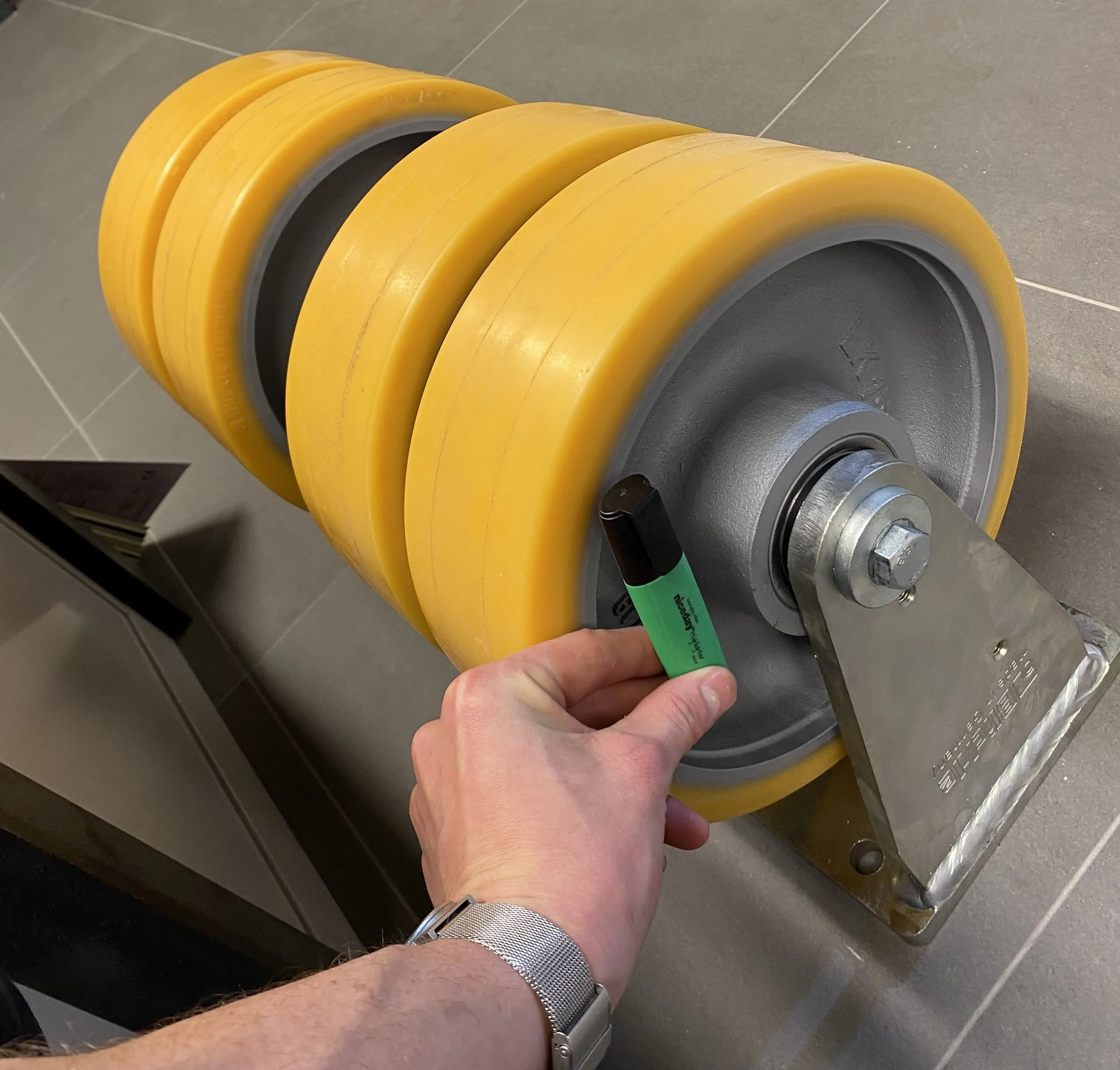
The wheels in question. Good wheels, wrong application.
I had watched the production team wrestling with the same handling problem for weeks, and I decided it was my job to fix it. I understood the constraints. I had the budget. I sketched out my ingenious solution. I specified the kit, placed a fabrication order for a triangular trolley contraption, and waited for the parts to arrive with the quiet satisfaction of a man who had single-handedly cracked it.
My solution was wrong, my design was wrong, and crucially non-refundable. My solution did not fit the application. The wheels were fine. It was my solitary decision-making that was not. The team humoured me for a while and then went back to doing it their way.
I kept those trolley wheels for the next eight years. They were moved from place to place, with the team slowly edging them closer and closer to the skip, but I kept them. A visual reminder of the same lesson: innovation is not something you do to the team. It is something you do with the team. The people closest to the problem hold information that the closest observer, however attentive, cannot see. Management does not sit above that knowledge. It sits in service of it.
That was the expensive version of the lesson. The cheap version came years later.
The skates that were already in the building
We had developed the production system to the point where our output was constrained by the square footage of the factory. The answer was to move from a static build to a dynamic production line, moving the modules down the factory, where the team, the tools and the material were waiting, turning circulation routes into productive floor area. This redesign of the production system was further complicated by the product being 10m long and 12 tonnes in weight. The factory floor was uneven and the budget was modest. What we lacked in capital, we made up for in resourcefulness.
I invited multiple salespeople offering a range of specialist solutions to the factory. Synchronised pneumatic jacks with integrated skates. Straddle lifters. Inset floor conveyors. Every quote was a serious chunk of capital, and every bespoke system came with its own installation burden, its own training requirement, and its own way of going wrong.
Then someone on the production team pointed out that the skates we already used to shuffle modules around the factory almost fitted inside a particular profile of steel channel we had in stock, the same material we used elsewhere in the build. Lay a length of that steel on the floor, pack it level, and you had a rail. Adapt the skate with a 4 inch grinder and drop it in the rail, and you had a track. It was the same skates we already owned, running on a piece of steel we already bought by the tonne.
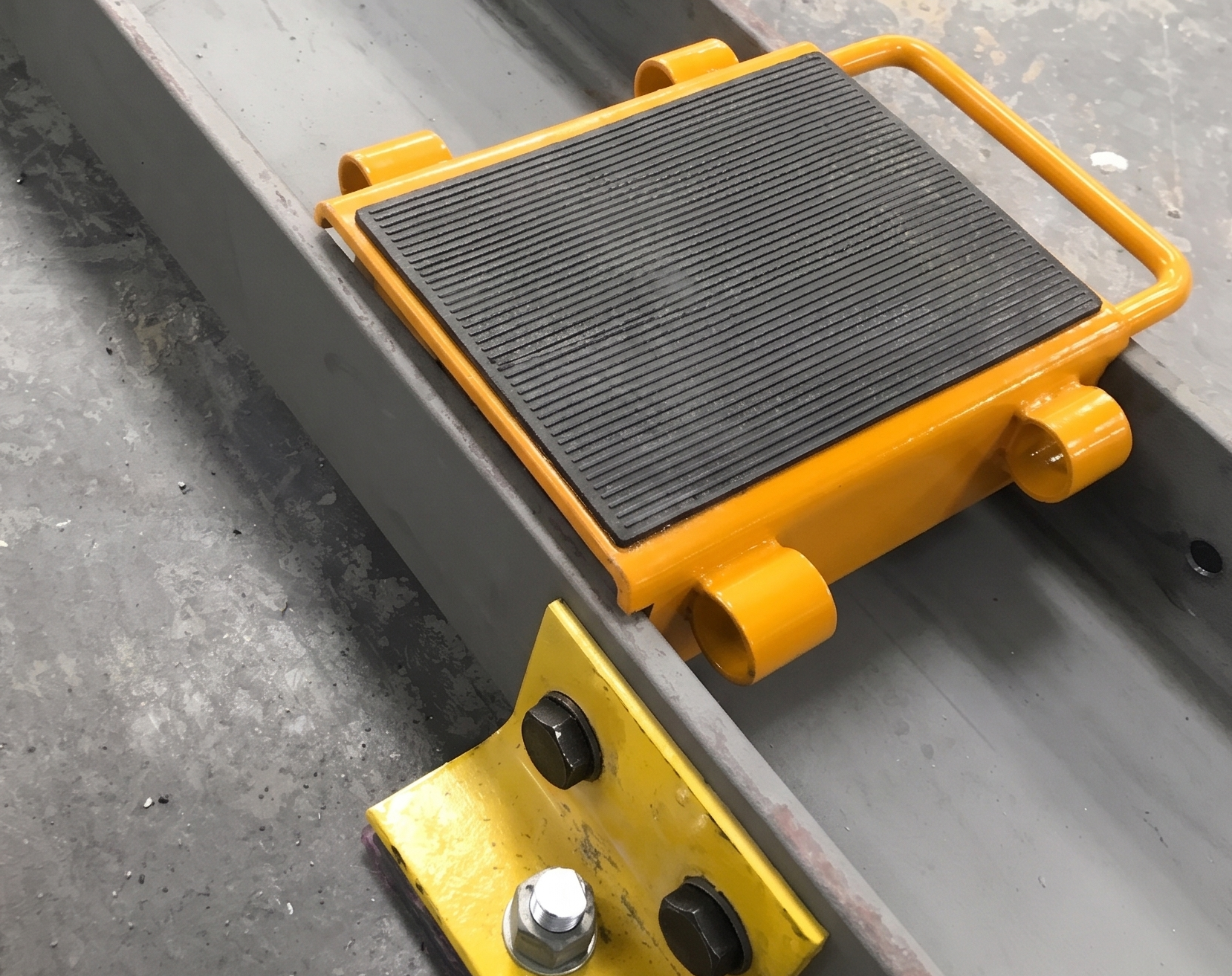
Stock material track and the almost made-to-measure skate
We built a prototype that afternoon. It cost almost nothing. It worked well enough to tell us what to change, and what we changed ended up being the system we used. Cheap to try, low risk if it failed, almost impossible to break, and infinitely adaptable once it was in.
The difference between the trolley wheels and the skates was not the depth of the thinking. It was the question I was trying to answer. With the trolley wheels I was asking "how do I solve this?" With the skates, we were asking "what have we already got, and what do we know?" One of those questions scales. The other one does not.
Why SMEs keep waiting
Over 99% of UK manufacturers are SMEs. Most of them are not going to buy a fleet of robots this year, and most of them know it. When the conversation turns to automation or innovation, the images that come to mind tend to be full ERP implementations, lights-out factories, robotic arms swinging through a paint shop. The price tag is enormous, the disruption is worse, and the risk of getting it wrong is existential for a business that does not have a balance sheet deep enough to absorb a failed transformation.
So nothing happens. The quote gets filed. The conversation gets parked until the next financial year, and then the one after that. The inertia is not a lack of ambition. It is a rational response to a framing that makes innovation look like a single large bet you either win or lose.
The framing is wrong. That is not what innovation in a small manufacturer actually looks like.
Lean manufacturing is, at its heart, a culture of small bets. Kaizen, the discipline of continuous incremental improvement, does not ask you to commit to a system-wide overhaul. It asks you to change one thing, measure what happens, and change the next thing. The investments are small. The payback is fast. The lessons compound. For an SME with limited capital and a factory floor full of people who know exactly where the friction sits, this is not a compromise version of innovation. It is the version most likely to work.
The good news is that the thing that unlocks this approach to innovation is free. The bad news is it is hard to build and fragile when you do. It is a culture of high agency and radical openness, where people know they can make suggestions, that failure is not punished but treated as a data point, that suggestions are listened to and acted upon, and that mistakes are raised early and discussed publicly. It is the cultural opposite of "not my job, not my problem."
The conditions that let tinkering work
A few things have to be true for this approach to deliver.
The people closest to the problem need to be in the room when the solution is being designed. Not consulted afterwards. Not surveyed. In the room. Their input is not there to secure buy-in. It is the critical information that decides whether the solution works or not. This may seem at odds in a world of Standard Operating Procedures, where we constantly reinforce the need for consistency and sticking to the documented process. But this approach allows, and encourages, shortcuts to be publicly discussed, reviewed, and if they work, adopted. Rather than people bypassing process with a more efficient but undocumented workaround.
The people with decision-making authority need to be in the room too, and they need to be there to support rather than to adjudicate. The job of the manager in a lean culture is to unblock, not to dictate.
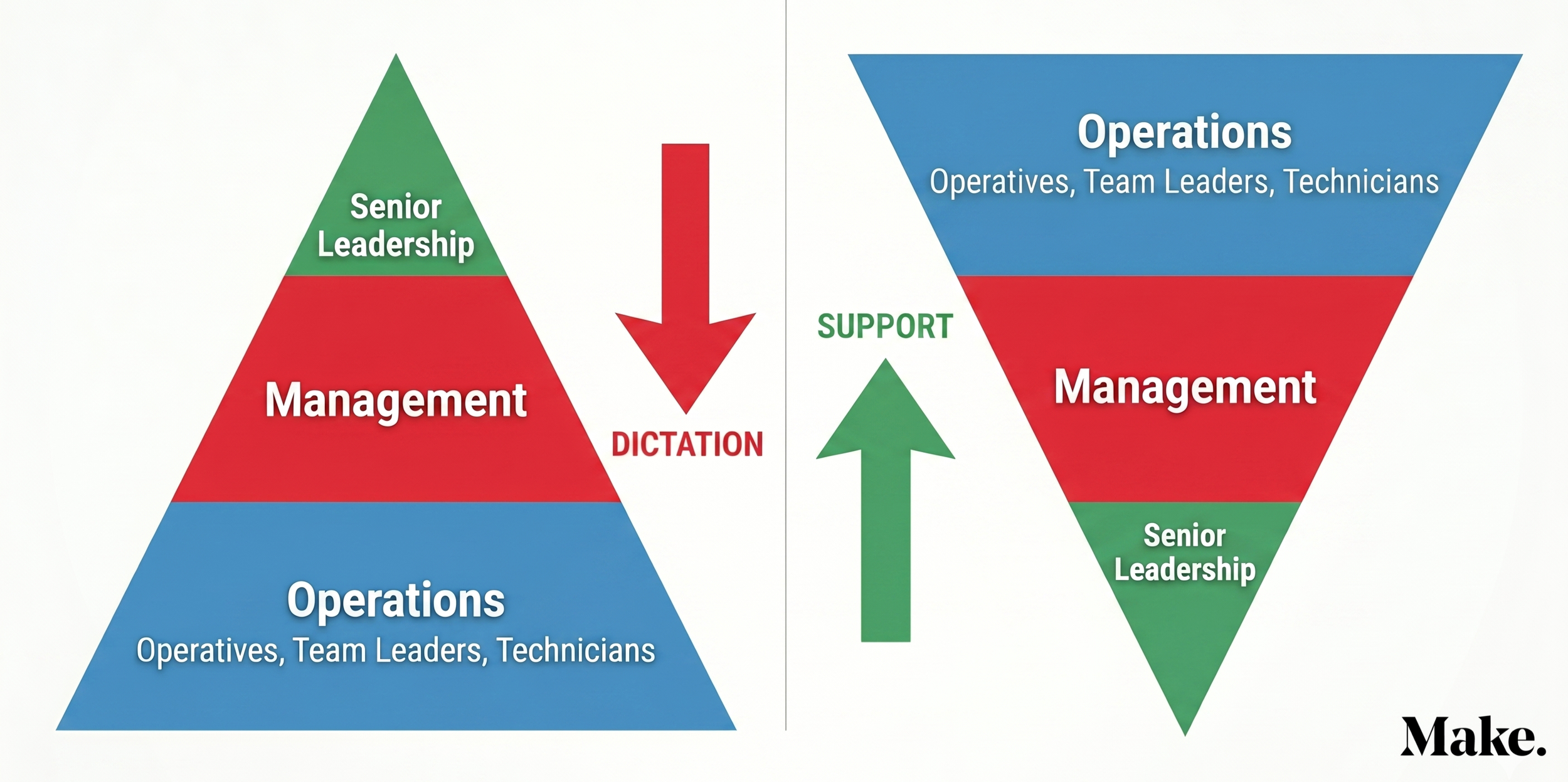
The shift that makes lean work: management stops dictating and starts unblocking.
The cost of trying has to be low enough that failure is not a catastrophe. This is where the specialists' quotes fall down. A £300,000 system that does not work is a disaster. A prototype built from stock material and an afternoon of the production team's time is a cheap lesson. You want to be in the business of cheap lessons, supported by a culture of radical openness where problems get raised the moment they are spotted. A problem is where the next improvement lives. None of that requires a robot.
Where to start
If you are running an SME manufacturing business and the word "innovation" makes you think of a large outlay, you are thinking of the wrong type of innovation. The most valuable improvements in most small manufacturers are sitting in the heads of the people on the floor, waiting for someone to ask, and costing a fraction of what you think they will cost to try.
The first move is a conversation with the people doing the work. Ask them where the friction is. Ask them what they would change if they could. Ask them what they have already tried. You will be given a list, and the list will be longer and more specific than any diagnostic a third party could produce.
From there, pick the cheapest thing on it and try it. Grant funding exists for businesses that have done the thinking, and the thinking is easier to do once you have something concrete to point at. The worst outcome is that you learn something and move on to the next item. The best outcome is that you have started the flywheel, and the next improvement is easier because of the last one.
I still think about those trolley wheels. Not often, but enough. They sat in that cupboard as a reminder that the best investments I ever made in a factory were not the ones where I had all the answers. They were the ones where I went in knowing I did not, and let the people who did do the talking. Collectively we tried, we failed, we iterated, and we solved that particular problem. And on to the next.
Most SMEs have ingenuity and ambition in spades, but need a nudge to start tinkering. If you have a list of things you want to try, I would love to hear what's on it.
George Palmer is the founder of Make Advisory, a consultancy helping UK SME manufacturers find the improvements already sitting in their factories and act on them. If this rings true for your business, get in touch.
