
It's a process problem, not a people problem
In the early years of building the production system at Boutique Modern, a modular building factory, we ran with low automation and a young team. We hired enthusiastic, mostly inexperienced people and put a few experienced tradespeople alongside them. The approach was to break the whole build, from structural steel through to second-fix joinery, into small, clearly defined tasks. Someone who had never picked up a drill before could become genuinely proficient at one specific task incredibly quickly. We didn't train a carpenter to frame a stud wall, fit a kitchen, floor a room and hang a door. We trained one person on one of those, repeatedly, until they were very good at it, with experienced team leaders overseeing the work.
It was a deliberate answer to a real problem. The skills crisis was already building and apprenticeship completions were falling. Training people to competence on a single element of the trade was a practical, low-barrier way in to the industry.
And the evidence backed it. Every team member could demonstrate they could complete their task to a good standard. Yet as output and headcount grew, so did the defects, and so did the hours lost to rework.
Was the whole plan wrong? Plenty of subcontractors who visited the factory thought so. The team was too inexperienced to deliver consistent quality, they said, and that was that. I didn't agree. Each person could prove they were good at the job in front of them. But I did agree that we had a consistency problem.
The answer was in how we managed quality, not in who was doing the work or how they did an individual task, but in how those tasks were standardised, measured and sequenced into a whole production process. In the early years, quality was managed on an individual basis. Each team member was trained on their defined set of tasks and encouraged to do each one "as well as possible". When the work fell below this ambiguous standard, the conclusion was one of two things: the work they had done was "bad" through a lack of skill or lack of effort, or they had completed their work as trained on top of substandard work completed by someone upstream of them. The policy was individualised, focused on a task-specific skill, and created a "not my problem" culture.
The turning point was treating quality as a process problem. We had no visible quality system on the floor that set out the specific measurements that needed to be achieved and recorded between each process, all linked together in an end-to-end quality management system. So we developed one. We wrote it out in plain language: the measurements, the test points, clear illustrations, colour-coded steps for each team, set in the right order, with sign-offs as each module passed from one team to the next, and the whole thing fixed to the front of every module as it moved down the line. The defect rate dropped through the floor: ninety per cent in the year after we rolled it out.
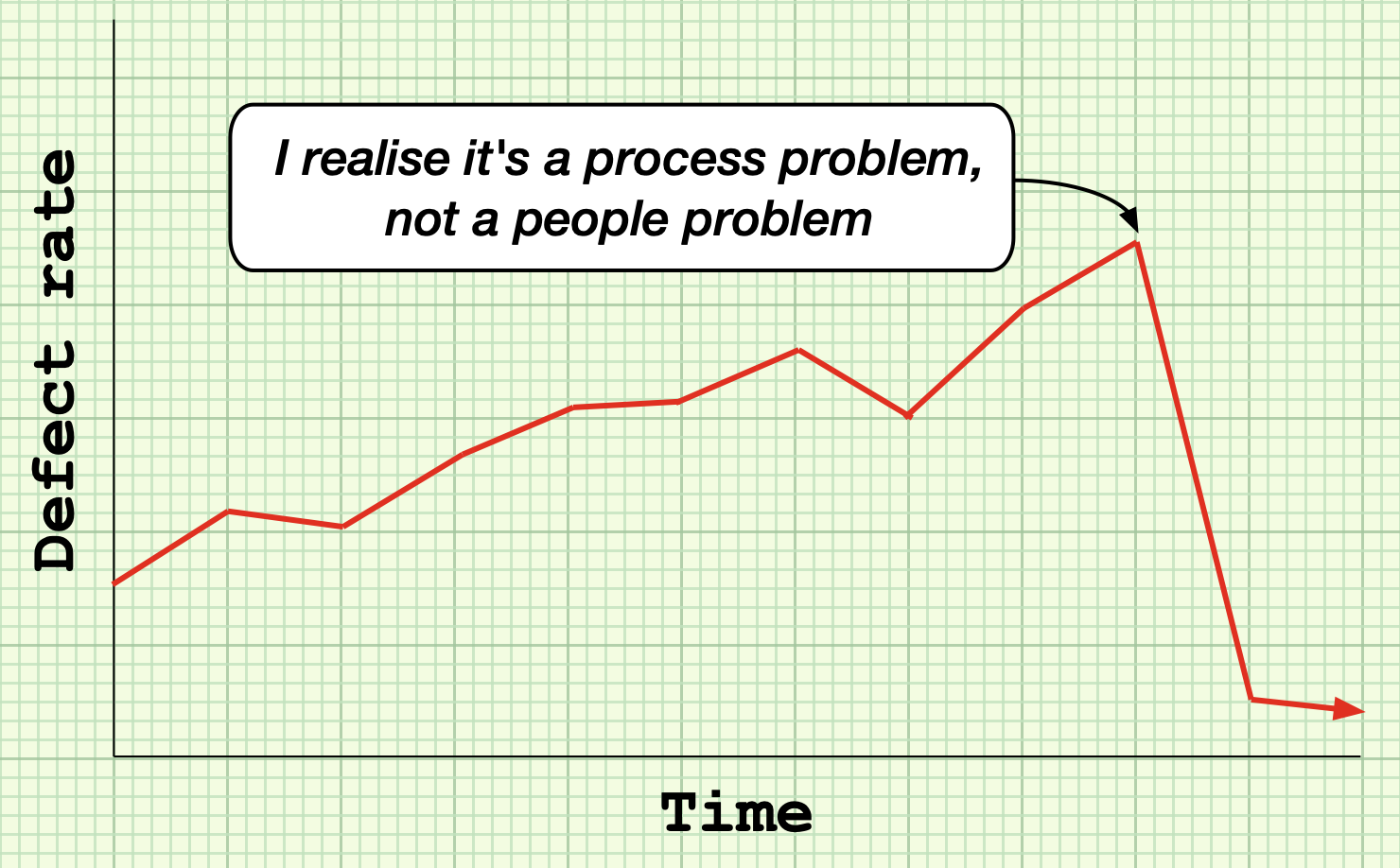
The bigger shift was cultural. Because the system was the thing being held to account, not the person, the whole team could improve it. Anyone could raise something to add at the morning stand-up. A richer system meant fewer defects passed down the line and an easier job for everyone, so people contributed to it rather than defending themselves against it. Raising a process fault carried no blame and no awkwardness that could be felt when pointing out a colleague's error. It was simply an opportunity to make the next module better and easier. This was the end of the "not my problem" culture. This is why it pays to see problems as process problems rather than people problems. If a person looks like the problem, that is usually the symptom, not the root cause. And it holds even for the problems that feel most personal. If you have ever thought "if I could just get rid of X, we'd be fine," you are looking at a symptom. Replace them and there is a fair chance you are having the same conversation about their replacement in six months. If a capable person can't complete the work you set them, that could be a training process problem. Even if you are convinced you hired the wrong fit, this could be a recruitment process problem. The person in front of you is where the pain shows up. The cause sits further upstream. The realisation that a business's performance is defined by the quality and compatibility of its processes is a liberating one, and is what makes a business more resilient. When you accept that your results are not wholly dependent on two or three exceptional individuals, you stop running the company in fear of them leaving. Good people still matter enormously, and you should build a hiring and retention process that attracts and keeps them. But if your people are operating a good process and one of them leaves, the process is still there to be picked up and run by the next capable person you bring in. The business survives the churn because the value lives in the system, not solely in the individuals passing through it. It changes how a business improves, too. Progress stops being a matter of anyone's fault or anyone's heroics and becomes the steady work of improving the process itself. Get that right and it becomes a self-improving system, as the people who work within it feel they have a part in improving the process, rather than keeping their heads down for fear of being treated as the symptom. The key takeaway: a strong team running a bad process will lose to even a mediocre team running a good, self-improving one.
If you have people problems that are really process problems, drop me a line.
